

Ireland
A Healing Journey for the Heart

Because of photos, this letter may be cut off in your email. Click on the title to read it from the site.
Last month, I traveled to a land of hedgerows and healing plants, of myth and magic, of saints and seaweed, of ancient trees and absent forests, of songs and stories, of legends and limestone…
Ireland wasn’t at the top of my travel bucket list. And after multiple experiences, group tours had moved down to the bottom of preferred travel modes. Then, several years ago, I came across the Wild Routes Ireland Living Landscapes tour, and it was this description that drew me in:
“We call our tours ‘Wild Routes Ireland’ for a precise reason, because we select our destinations for either their outstanding natural beauty or their ecological, cultural, or mystical significance. You won’t read about them in guidebooks and are unlikely to find any other tour that includes them. We’ve also formed deep relationships with some of the country’s most respected guides and experts in forest ecology, herbalism, wild food foraging, traditional storytelling, and more to share their passions with you.”1
The last five years have been filled with significant loss in my life, and I have been tending to my grief and anxiety quietly on my rural homestead. It had been years since I traveled, but I didn’t want to travel for the sake of simply doing another trip. I wanted an experience that could build on my deep connection to land and nature, which I knew would be a kind of healing balm for my heart and soul. On June 27th, I flew from Portland, OR to Shannon, Ireland, and joined the tour on June 29th.
There were 21 of us: moms & daughters, best friends, partners, and solo travelers like me. What we had in common was a curiosity and wonder for the natural and cultural history of Ireland. We talked, listened, sang, laughed, shared, sat in silence, stood in awe, and practiced reverence for the land and its stories. On our last day, our closing circle was emotional as we shared our gratitude and wishes.
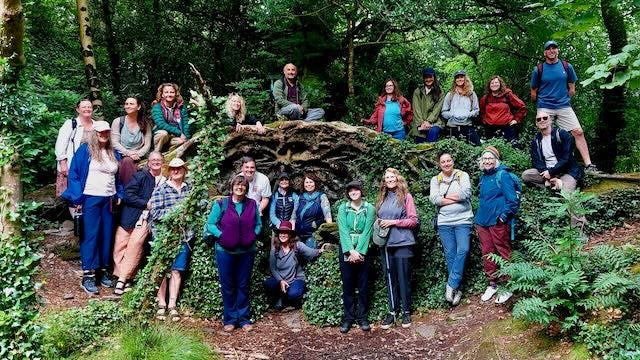
Wild Routes Ireland’s founders, Tara and Chris, both herbalists, were partly inspired by herbalist Rosemary Gladstar’s Plant Journeys. In addition to their own expertise, they engaged a remarkable group of local guides, storytellers, herbalists, and activists who shared their deep relationship with the land and its history. Lorna and Zillah kept us organized, properly accounted for each day (no bodies left behind), and offered daily doses of crystallized ginger to ward off motion sickness. Fred, who has an encyclopedic knowledge of Ireland and its natural and cultural histories and a wry sense of humor, drove our bus each day, sharing his knowledge and occasional opinions with us. The entire tour was thoughtful and designed to be experienced. The food was delicious, and our accommodations were incredible. It was the best group tour I have experienced - truly magical.
The Island
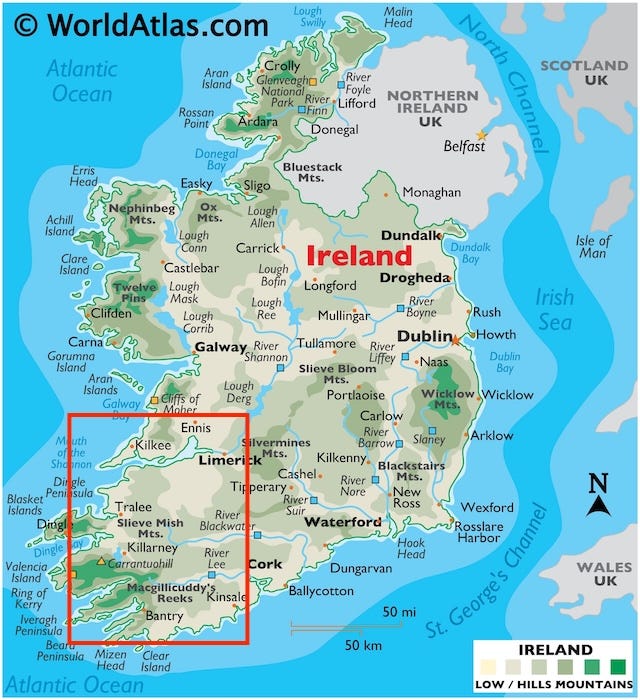
At 300 miles north to south and 175 miles east to west, Ireland is the third largest island in Europe and the 20th largest in the world. Coastal mountain ranges encircle a flat central plain.
Bordered by the North Atlantic Ocean, Ireland’s south-west coast is a series of deeply carved inlets and mountainous peninsulas. It’s a rural landscape, remote, with pockets of green wildness, and small farms and villages dotting the narrow two-lane roads. Our daily explorations focused on this southwest region, which meant our time on the bus was limited to 2-4 hours each day, which is a blessing. We explored the coast, national parks, protected woodlands, two unique farms, Holy wells, ancient fairy forts, and ruins of early Christian churches. What some of us thought was a large lake turned out to be the River Shannon, the longest river in the British Isles.
Ireland’s climate is temperate, with mild winters and layers of misty morning clouds in the hills. The west coast experiences twice as much rain as the rest of the island, contributing to the many shades of green life. During our tour, much of Europe was in the midst of a harsh heatwave, but our temperatures were moderated by the maritime influence.
The Forests
After the last ice age, Ireland was almost entirely covered by forests of mostly deciduous trees: hazel, witch elm, oak, ash, willow, alder, holly, hawthorn, blackthorn, and the evergreens, Scots pine and yew, are some of the land’s 28 native tree species. Revered and protected, trees were central to the Celts' daily lives and cosmology. As more humans began to settle on the island, the forests slowly shrank, and centuries later, Britain’s colonization of Ireland ramped up the deforestation, shipping the wood out of Ireland. By 1900, Ireland had lost 99% of its native woodlands.2 One of our guides explained that the Irish are a forest people without a forest. An important lesson if only we would listen…


The Stones
As curious as I am about plants, I was more than intrigued with the ancient stone circles, stone fences, the ruins of stone churches, and the art of building with stone, which was perfected by the invading Normans.
On our second day, we traveled to the limestone landscape, The Burren, a national park that hosts a remarkable diversity of Arctic, Alpine, and Mediterranean plants.3 St. Colman MacDuagh (along with a servant,…as one does…) set up a hermitage in a cave around 595 AD. The third photo shows what may be the servant’s grave.


Stone forts were designed for defense purposes, and families would move their livestock and goods into the fort for protection from invaders. Cemeteries are filled with untold stories, but occasionally a simple phrase offers a glimpse of a historical tragedy. This grave contained the bodies of parents and their son who died at the young age of 17. I couldn’t decipher the last words of the phrase, “Shot by the B…” I asked one of our guides, and she knew immediately: “Shot by the Black and Tans.” Recruited by the British government to stamp down the Irish War of Independence, the Black and Tans were constables known for their brutality and often targeted civilians.
The Water
Water is abundant in western Ireland: the Northern Atlantic Ocean, rivers, creeks, waterfalls, lakes, holy wells and springs.


We visited with a seaweed/hedgerow forager, and she prepared a delicious lunch for us. Seaweed harvesting has been a traditional lifestyle for centuries; now it's threatened by seaweed-processing corporations that want to harvest on an industrial level for carrageenan gels used in cosmetics.
The Land
In between the wilder landscapes were small farms divided by hedgerows. Agriculture is a major industry in Ireland: 18,000 farms support the Irish dairy market, and over 6 million beef cattle contribute to the large export of beef to the European Union. Sheep farming is done in the hills, where grazing is sparse but spread out. As a fiber lover, I was disappointed to learn that the Irish wool industry has collapsed and the sheep we saw were raised for meat.


The Stories
I returned home with hundreds of photos and joyful memories of meeting new people and sharing experiences. Though I live a lifestyle centered around the natural world, this trip highlighted the incredible power and importance of stories that weave the relationship between nature and people. One of our guides, Ted Cook, a gentle soul, woodland activist, and writer, implored us to protect nature, to remember that as we love nature, she loves us; and most importantly, she needs us. Later, while sipping water from a Holy well, he recited Wendell Berry’s poem, The Peace of Wild Things. I thought I was recording his recitation but realized I forgot to hit the record button! But I caught this:
Entering US Customs at Shannon Airport to return to the PNW, an Irish woman first checked my passport to ensure I was in the right place. There was nobody else in line, and I had an apple to eat before I could go through customs, so we chatted. She asked about my time in Ireland, and I gushed about the many shades of green, the stone walls & ruins, the water, the hedgerows, the small farms with small herds of cattle, dairy cows, and sheep.
She smiled and said, “Ya know, it’s in our DNA.”
I asked, “Farming?”
“Well, yes, but it’s really about the land. The land is in our DNA.”
Returning to Ireland for another tour did not occur to me until I settled back home. For the first week home, I dreamed of places we visited: woodland walks, ancient fairy circles, limestone landscapes & architecture, farms, and seascapes. I felt a connection, a sense of place with the verdant Irish landscape. So, who knows, maybe I will return…
Until next time…
Sue
P.S.
I brought along Maggie O’Farrell’s (Hamnet, The Marriage Portrait) latest book, Land, and read a bit each day. Set in mid-1800s Ireland, after the devastating Great Hunger, the story is of a struggling Irish family that turns to the wilder, rural land on a peninsula to create a more hopeful life. The land is more than a setting; it is a character in the story. If you can’t travel to Ireland, I recommend this book as the next best thing.
https://www.wildroutesireland.com/
https://www.reforestnation.ie/blog/irelands-vanished-forests-where-did-they-go
https://www.ireland.com/en-us/destinations/regions/the-burren/
The Algorithm Game relies on likes and restacks. If you enjoyed this, please like and restack.
It totally sounds like a wonderful trip.
I've had two trips to Ireland, the first around a week-long writing retreat in 2015 in western Ireland, with my hubbie along for the 3 week trip.
The second was a month at a HomeExchange place near Sligo, on my own, originally planned
for both of us, but we had an old dog then, and my husband took him directly to Quebec that year.
It was a wonderful time, too, as I had our HE partner's old car to use, and explored all sorts of places near there. Amazing.
I especially loved the Slieve League Cliffs north of Sligo where the Appachians emerge. And so many other things.
The photos are breathtaking, Sue! Your narrative is fascinating and rekindles memories of a trip to Scotland my husband and I took many years ago. We found magical places to hike and explore, and also found a great sense of peace and connection to the natural world surrounding us. Your experience sounds fantastic!