

Seeking the Spectacular
While Missing The Forest for the Trees

Autumn arrived last month, gently persuading the summer’s heat to take a long rest. Sunny days without the hot temperatures of summer are a welcomed gift. I have been immersed in harvesting and preserving the abundance of my garden, but by October, I am ready for a break.
I’ve been thinking about a short hike in a well-hidden grove of ancient trees less than an hour from my home. The grove is a 170-acre ancient forest remnant on the Washington side of the Columbia River Gorge. Though on publicly-owned land, the grove is not easy to find. There are no hike descriptions, no hike reviews, and no mention of the hike on the USDA Forest Service website, where I checked for road closures.
The Forest Service roads to the grove are open, but I am disgusted at the new banner posted on every federal website:
“The Radical Left Democrats shut down the government. This government website will be updated periodically during the funding lapse for mission critical functions. President Trump has made it clear he wants to keep the government open and support those who feed, fuel, and clothe the American people.”
A reminder of the daily middle school bullying mentality and ugliness projected by this dangerous regime.
All the more reason to go to the woods.
I’ve been hiking Pacific Northwest conifer forests for 35 years, and each time I step onto a forest trail, I feel euphoric. I packed my backpack, inserted the top-secret (seriously - you have to know the right people to get it) printed map into a plastic sleeve, and hit the road.
The directions to the grove are detailed, advising me to zero out my trip odometer once I leave the highway, make a series of turns at 5.1 miles, 7.2 miles, and 9.2 miles, and then look for a 90-degree bend at 12.7 miles. There is a widened spot along the narrow forest service road, big enough to allow two small cars to park. Stepping out of my truck, I immediately smell the forest, breathe deeply, and smile.
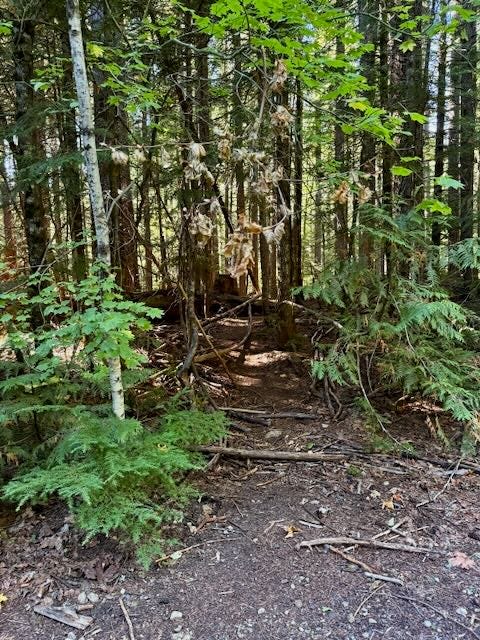
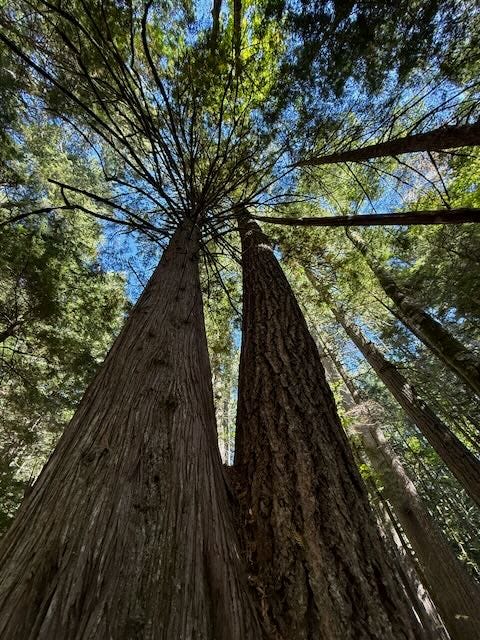
I slowly walk along the edge of the road, looking for an opening, the only indication of the unmarked trailhead. If you weren’t looking for this unmarked trailhead, you’d miss it. There are no signs. I think I have found it, and as I step through the opening, I feel like I am entering into an imaginary landscape of oversized trees, filtered sunshine, and hushed silence. This forest hosts some of the oldest and largest trees in the Columbia River Gorge.
I glance at the map for directions to start the 1.5-mile loop trail. The trail directions have two sentences:
Best to hike the loop clockwise. Take a sharp left along the backside of a large rotten log where the trail starts.
There are downed, rotting logs everywhere, so I am a bit annoyed at the contrast of the detailed driving directions and the lack of detail for the actual hike. I consider my annoyance: is it based on a fear of not being in control? A wild and untamed unknown? How often do I explore the unknown?
I ignore the words “sharp left” and walk forward on what looks like a trail. The trail is faint, and I am suddenly tuned into every step I take. I stop often to look ahead for the trail and, more importantly, to look around, establishing a visual memory of my location. Every year, hundreds of people get lost in PNW forests. Most are lucky enough to be found by search and rescue volunteers, but some die or simply disappear. I am an experienced trail hiker, but I have felt the heart-thumping panic of disorientation in a landscape.
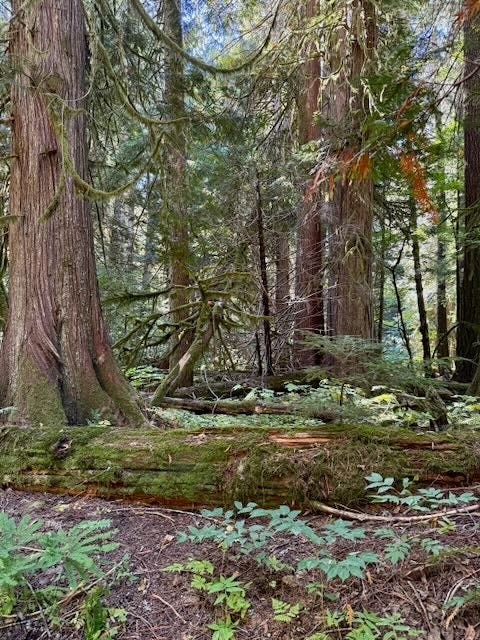
According to the person who provided the map, the forest was selectively logged back in the 1970s and experienced a wildfire in the late 1800s. There are massive stumps here and there, and downed cedars everywhere, their shallow roots draped in moss, nature’s offering of botanical art.
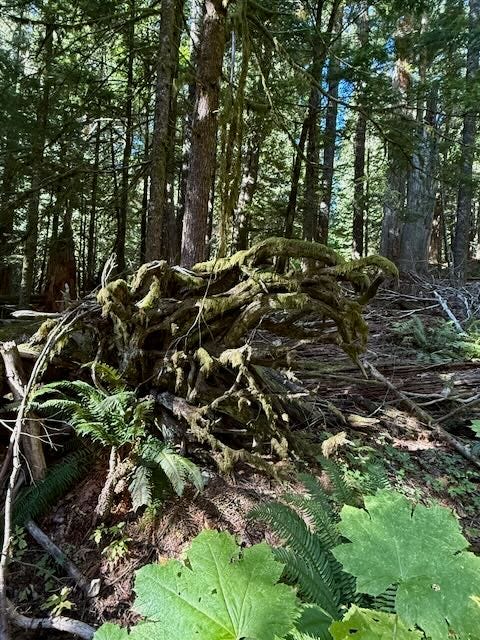
As I descended into the forest hollow, I scrambled over some of the downed trees and practiced my front-forward limbo skill under others (note to self: increase those daily squats and lunges).
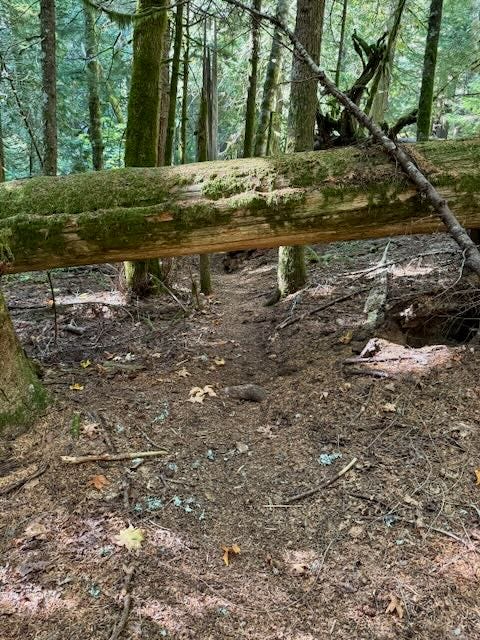
The trail ended at a mostly dry seasonal creek, criss-crossed with fallen trees. Frustrated, I sit down to review the map again and return to where I started to look for a trail along THE rotting log. I find it, though it’s less detectable than the one I just walked.
Stopping frequently to focus on the trail ahead, which winds around trees and seems to disappear here and there, I notice occasional human-made trail markers: fallen trees with chainsaw-notched portals. I whisper my gratitude to those who helped maintain access.


I feel the tension of the uncertainty and the trail’s insistence that I be 100% present. I think about how modern humans often mindlessly walk the well-known paths of our daily lives. We seek the fantastic and beautiful to feel more alive.
I remind myself to regularly note my surroundings by identifying plants I know well, such as Oregon grape, wild ginger, sword fern, and the occasional fungi and lichen growing on trees.


As I wind along the trail, I begin taking photos of some of the twists and turns…just in case I lose my way. I have a compass in my backpack, but I should have used it to establish my starting place. It’s been a long time since I hiked something not known or marked. The forest of standing and downed trees begins to look the same, making it easy to lose my way. I don’t want my 15 minutes of fame to be a local news story of yet another lost hiker in the Gorge!
A lone Douglas squirrel, clinging to the bark of a giant Douglas fir, begins an alarm call, notifying the forest that there is an intruder. I stop to listen and look around. Who is listening?
I arrive at the “camp spot,” one of two trail features noted on the map. I am comforted by its domesticity; considerable effort was made to build the large fire ring and set up the square of seating. I would love to camp here for a night or two.
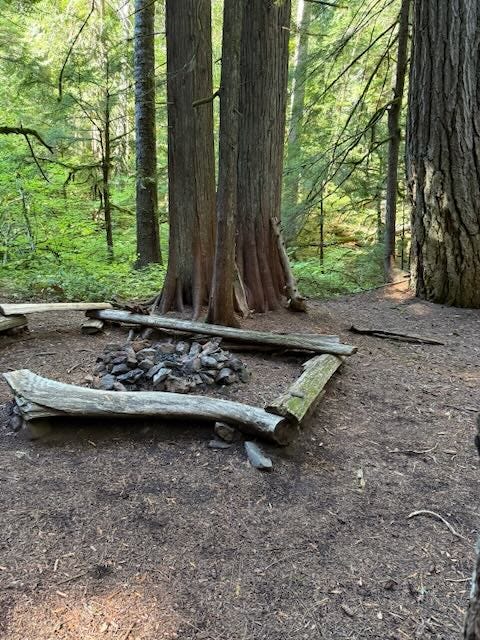
I sit and look at the map again. The trail seems to have disappeared again. Looking around, I see something that looks like a trail. I follow it, ending at a large patch of the thorny devil’s club, a PNW plant that is designed to discourage passage of any kind. I return to the camp spot, feeling disappointed.


It was now mid-afternoon, and I wasn’t comfortable continuing to look for the trail that would lead me to my intended goal: visiting several spectacular ancient trees with diameters of 6-8 feet. At that point, it occurred to me that the faint trail was perhaps the point: I was missing the forest for the trees. I was sitting alone in the silence of a rare ecosystem, surrounded by old trees that had stories to tell. I reflected on a passage I read recently in the book, The Bear, by Andrew Krivik:
The trees are the great and true keepers of the forest, he said, and have been since the beginning. Some animals of old have said it was the trees themselves that taught them to speak, for they never make unnecessary sounds. Each word, like a breath, carries with it some good, some purpose. For this reason, trees are the wisest and most compassionate creatures in the woods. They will do all in their power to take care of everyone and everything beneath them, when they have the power to do it.
I return the way I came, grateful that I took the time to imprint my short-term memory with images of the trail. Circling a large tree, I see my red bandana that fell off my backpack, lying on the trail. I smiled as I thought of Hansel and Gretel, who left a trail of breadcrumbs to guide them home, but the birds ate them. The red bandana is a far better breadcrumb.
I walk slower, without a final destination of spectacular ancient trees to energize me. I hear the distinctive jackhammering of a pileated woodpecker, our largest species of woodpecker. Searching for ants to eat, they prefer the dead snags and downed wood of old forests, so they, like old forests, are becoming less common.
I trudge up out of the forest hollow to the trailhead, take a last look around, and return to my truck. My body is tired, my knee is sending messages of mild pain, but I am calmer and wiser for my afternoon of forest therapy. Looking at the map, I am already planning another visit before the snow arrives. I will find those ancient trees.
Last week, I shared how anxiety was making my body ill. This forest adventure was part of my medicinal therapy.

Thank you for reading. If you value this kind of writing, please consider sharing it via email and on social media.
Liking and restacking this post encourages others to read it.
You can take out a paid subscription to this Substack for as little as $5 a month.
Tell us about your moments of traveling the unknown in nature.
It reminds me of a walk I took from our remote cabin in Alaska. With a creek on one side and the Alaska Range due North, it seemed like a good idea at the time. The June day got cloudy, obscuring the mountains. The creek met its tributaries. It rained. I lost my head net and the mosquitoes attacked my face. Eventually, I acknowledged that we were lost. Our dog Ella was still having a great time, and when I told her to take me home she continued on her path in all good cheer. I stopped her and repeated my command, and each time she continued north, or so I thought. I commanded her again, and she sat down, clearly saying "you can lead or you can follow, just make up your mind!" So I followed and she took us safely home. Gary said he couldn't have come looking for me, as I had his dog! And he predicted that with the 50 or 100 mosquito bites I would become immune to them. For a couple of years after, mosquito bites didn't swell or itch. Thanks, Ella! Good dog!
A most excellent adventure, Sue!